

WHERE OTHERS SEE OBSTACLES,
WE SEE OPPORTUNITY.
At Orion Space Solutions, we're leading the charge into VLEO. Through space environment sensors, high precision orbit prediction, and drag-reduction solutions, we are making VLEO a sustainable and mission-ready domain for defense and commercial applications.

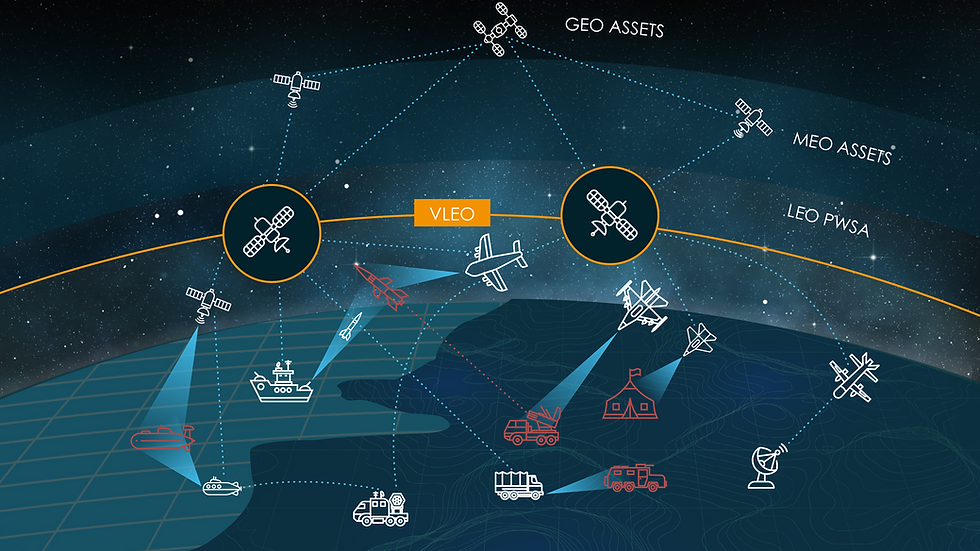
Adaptive technologies for VLEO operations:
We leverage AI-driven data processing and advanced modeling to optimize Earth observation and operational performance in VLEO missions.
CORE VLEO CAPABILITIES
Mission design solutions:
Our end-to-end mission design streamlines satellite production, data analysis and operational efficiency for VLEO applications.
Advanced sensor development:
We develop specialized sensors optimized for the VLEO environment, using advanced materials to enhance performance and resilience in challenging atmospheric conditions.
WHY VLEO?
Situated closer to Earth than traditional low Earth orbit (LEO), VLEO offers unparalleled opportunities for innovation and advancement in space technology and applications.

Untapped Real Estate
VLEO provides a low-altitude orbital zone ready for new satellite missions, free from the congestion of higher orbits

UNMATCHED SIGNAL POWER
Closer proximity to Earth delivers clearer, stronger communication signals, maximizing system performance and data reliability

Strategic Positioning
VLEO delivers higher-resolution imaging, faster data transmission and a unique perspective for capturing critical environmental and atmospheric data with precision

RADIATION SHIELDING
The dense atmospheric layer provides natural protection against harmful radiation, safeguarding satellites and extending mission lifetimes

COST-EFFICIENT OPERATION
Advanced orbit propagation enables lights-out operations
CAPABILITIES AT WORK
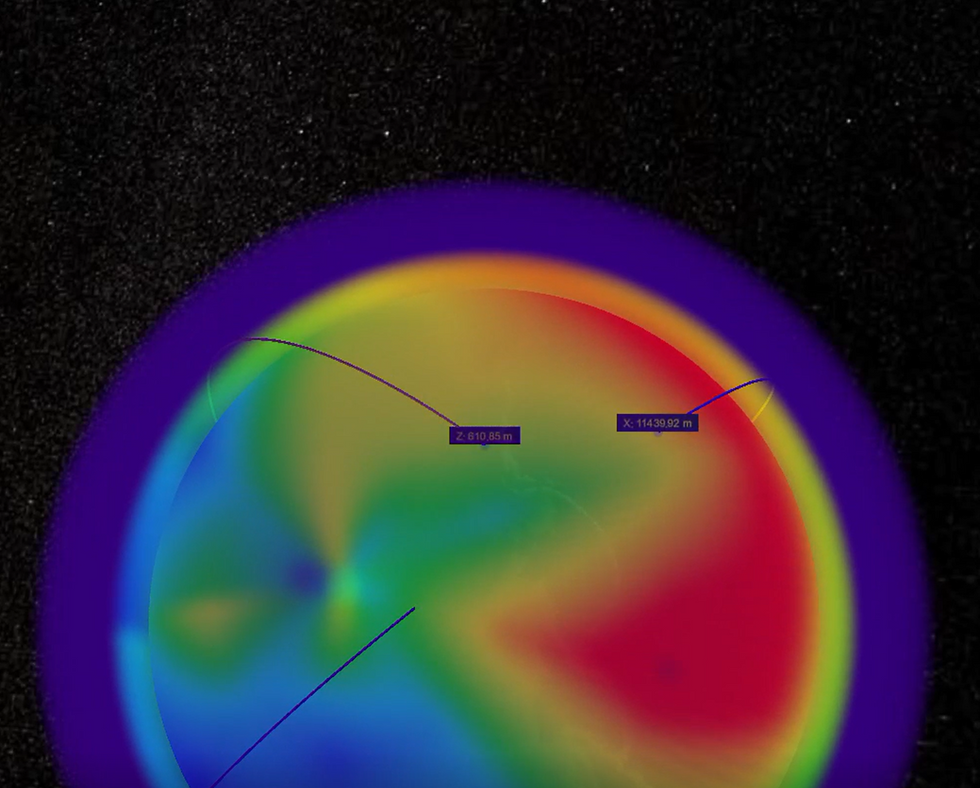
Atmospheric density data accuracy
Our proprietary OrbitIQ tool surpasses existing models in precision and improves thermosphere density and drag predictions to strengthen orbit determination and maneuver planning

Advanced concept of operations (CONOPS)
Our suite of space weather sensors make "in-situ" and remote observations of the VLEO environment, providing instantaneous feedback, data and CONOPs refinement

Drag reduction efficacy
Our VLEO space vehicle design includes geometries and materials that minimize atmospheric drag and environmental degradation, significantly increasing satellite longevity and reducing the frequency of replacements

As the prime performer on the DARPA-sponsored Ouija mission, Orion will conduct "in-situ" and remote sensing observations to characterize space weather dynamics in VLEO and demonstrate new operational techniques in this uncharted domain. This pathfinding mission will be performed by our Kraken spacecraft and features a highly integrated and comprehensive instrument suite designed to measure key parameters such as electron density, ion composition and neutral atmosphere interactions. Kraken is a brand new 27U CubeSat, with the sole purpose of demonstrating innovative technologies for operating in the challenging VLEO environment. This mission is set to launch in early 2026.
UPCOMING VLEO MISSION: DARPA OUIJA

A Closer Look at VLEO: The New Frontier in Orbit
As the fast-evolving commercial satellite sector looks to leverage the advantages of Very Low Earth Orbit (VLEO), situated at the edge of space in orbits between 250 and 400 kilometers above the Earth’s surface, several satellite firms see it as transformative for commercial and defense space applications.

Low Altitude, High Stakes: Why VLEO Will Decide Military Superiority
For decades, space dominance was defined by how high and how far nations could go. Modern warfare is changing that equation, bringing the fight closer to Earth. Some of the most critical battles for intelligence, defense and security won’t take place in deep space or Geostationary Orbit (GEO) —they will unfold in Very Low Earth Orbit (VLEO), just 200 to 450 kilometers above the surface.

LEO's looking a bit crowded, what about heading south a bit?
Space enthusiasts and hopefully listeners of this show know the term LEO, or low Earth orbit gets tossed around a lot, but what about VLEO, that’s very low Earth orbit. Well you may begin hearing that phrase more and more. Orion Space Solutions announced the successful completion of a test readiness review (TRR) for the Defense Advanced Research Projects Agency (DARPA) Ouija program VLEO mission. It’s slated to launch this summer and could open up the potential for more activity in that space. For an explainer about this program and VLEO information overall, I talked with Chad Fish, President and GM of Orion Space Solutions.

Can LEO Satellites Transform the Future of Connectivity?
As terrestrial broadband capabilities become increasingly saturated, low earth orbit (LEO) satellites emerge as a dynamic solution, capable of delivering high-speed, real-time data transmission with minimal latency. Positioned closer to Earth, these satellites offer a shorter and faster data transmission path, enhancing communication speeds and reliability. This advancement is particularly significant for data-intensive, industrial, and business-oriented applications, where real-time data exchange is crucial.


SPACE SUPERIORITY IS MUCH CLOSER TO HOME
Ranging from 200 to 400 kilometers above the Earth, VLEO benefits from reduced free space loss enabling higher speed data transfer, sharper Intelligence, Surveillance and Reconnaissance (ISR), unique communication modalities, greatly increased protection from the solar radiation environment, and enhanced resilience against modern threats.
