Unveiling the hidden connection between Earth and sky: How natural and human-made events affect the ionosphere
Austin Egert, Director of Atmospheric Physics
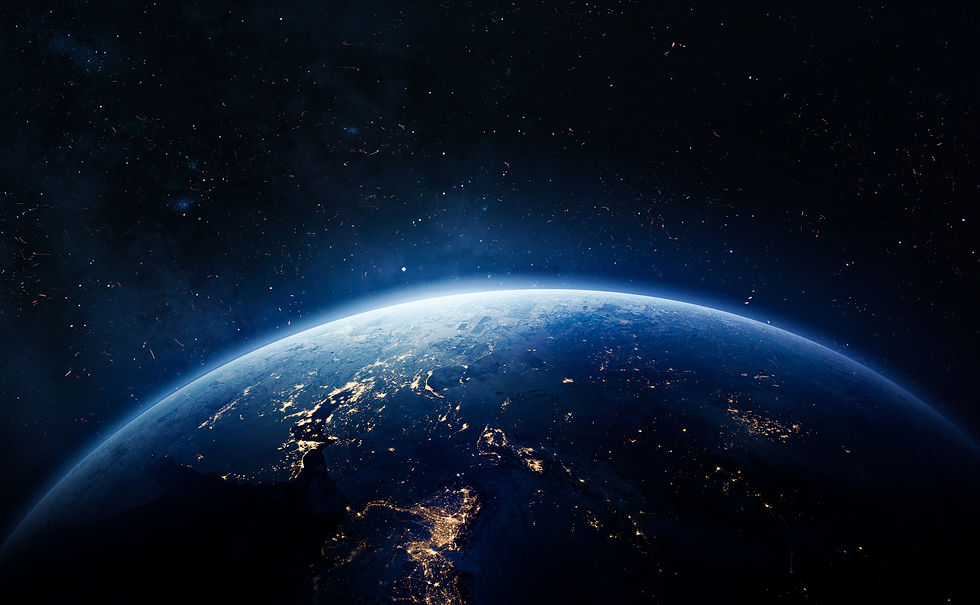
When we think about the ionosphere—a critical layer of Earth’s atmosphere that includes the thermosphere and parts of the mesosphere and exosphere—we tend to focus on impacts from the Sun. Solar flares and geomagnetic storms are well-known triggers for ionospheric disruptions. But what if some of the most profound changes in the ionosphere originate here on Earth? Earthquakes, tornadoes, volcanic eruptions, hurricanes and even human activities have ripple effects that extend all the way to the ionosphere, influencing its dynamics in ways we are only beginning to understand.
Thanks to advancements in satellite technology and atmospheric research, Orion is uncovering the unique ways that Earth-based events influence the ionosphere’s density, temperature and electron profiles. These revelations open new possibilities for predicting and mitigating disruptions, supporting industries ranging from telecommunications and global navigation to aviation and defense.
HOW EARTH-BASED EVENTS MODIFY THE IONOSPHERE
While this region of Earth’s atmosphere is primarily influenced by solar conditions, it is also sensitive to terrestrial phenomena. Ground-based events like seismic activity and hurricanes create waves of energy—acoustic compression waves and gravity waves—that propagate upward through the atmosphere. These disturbances can lead to density and temperature variations in the thermosphere and ionosphere, ultimately altering critical electron density profiles in the lower two regions of the ionosphere. Why does this matter? Because these variations can modify how radio and navigation signals propagate, impacting the reliability of communication and positioning systems.
SEISMIC AND VOLCANIC ACTIVITY
From earthquakes to explosive volcanic eruptions, Earth’s dynamic crust isn’t just shaking the ground, it’s sending energy skyward. Satellites like the Global Navigation Satellite System (GNSS), the Global-scale Observations of the Limb and Disk (GOLD) satellite, the Thermosphere Ionosphere Mesosphere Energetics and Dynamics (TIMED) satellite, and the Insight-Hard X-ray Modulation Telescope (HXMT) have observed significant effects of seismic activity in the ionosphere. As acoustic compression waves travel upward into the thermosphere, they cause noticeable perturbations in atmospheric density, which in turn, influence electron distribution and signal propagation.
STORM-DRIVEN CHANGES
Storms, hurricanes, tornadoes and severe thunderstorms also play a role in influencing the ionosphere on Earth. Using tools such as GNSS, GOLD, ICON, COSMIC-2, and even weather satellites like GOES-17, scientists have observed substantial perturbations in thermospheric temperature, circulation and density patterns caused by these weather systems. Hurricanes, for example, can induce changes through a process known as convective coupling, in which energy from the atmosphere’s lower layers reaches the thermosphere. The result? Electron density shifts that can significantly alter the ionosphere’s interaction with very low and high frequency radio waves.
THE ROLE OF HUMAN ACTIVITY
Beyond natural events, human activity can have ripple effects on the ionosphere, too. From rocket launches to large-scale energy releases, these human-caused events mimic the atmospheric changes caused by natural phenomena, further complicating the ionosphere's behavior.
SIMULATING AND PREDICTING IONOSPHERIC VARIATIONS
Understanding these phenomena is no simple task. That’s where cutting-edge research, models and simulation come in.
Starting with the Naval Research Laboratory Mass Spectrometer and Incoherent Scatter radar Extended (NRLMSISE-00) model, which describes how the air’s density and temperature change from the ground-to-sky under normal conditions, researchers apply a process called static compression effect (SCE) to simulate how air movements, like gravity waves caused by weather, alter normal conditions. Next, by incorporating this model into the International Reference Ionosphere (IRI), scientists can explore how these changes affect charged particles, like electrons and ions.
But how do we measure the real-world implications of these changes? To find this out, scientists use another tool—the High-frequency Channel Impulse Response Function (HiCIRF) model developed by the Northwest Research Associates—to simulate how over-the-horizon (OTH) radar transmissions travel through the disturbed atmosphere. These simulations reveal how signal power and propagation are altered by the disturbances. Comparing the results from disturbed and normal ionospheric conditions, provide critical insights into how ground-based events can impact radar and communications systems that rely on signals traveling through the ionosphere.
WHY THIS MATTERS FOR INDUSTRY AND INNOVATION
From improving the reliability of global positioning systems to bolstering defense capabilities and enabling better disaster preparedness, understanding Earth’s influence on the ionosphere has far-reaching implications. Whether it’s the quiet ripple of an earthquake or the launch of a missile, these terrestrial forces leave an indelible imprint on the skies above, challenging us to rethink traditional boundaries between Earth and space sciences.
By harnessing advanced models and observational data from next-generation satellites, we are getting closer to predicting ionospheric behavior in real time. Through effective collaboration—uniting scientists, technologists, and industry leaders to understand and mitigate the cascading effects of both natural and human-made disruptions—we will not only enhance our technological infrastructure, but ensure the resiliency of critical systems in an increasingly interconnected world.
For more expert insights on space science research, visit orion.arcfield.com/knowledgexchange.
ABOUT THE AUTHOR
Austin's scientific journey began with a childhood fascination with planets, sparked by viewing Saturn through a telescope on Halloween night. Despite initial challenges with physics and computer programming in college, he discovered a passion for conceptual physics that led him to pursue a bachelor's degree in the field.
His career took an unexpected turn when he joined Intel Corporation as an electromagnetic compatibility engineer before completing his degree. Later, while pursuing his doctorate in physics, Austin developed programming skills in MATLAB, FORTRAN and IDL to model Jupiter's ionosphere. Today, Austin works as a scientific programmer modeling Earth's ionosphere, effectively combining his interests in science, space, and computer programming.


