

Strategic stargazing: Revolutionizing how we position instruments to study Earth's polar atmosphere
Matthew Cooper, Ph.D., Aerospace Engineer
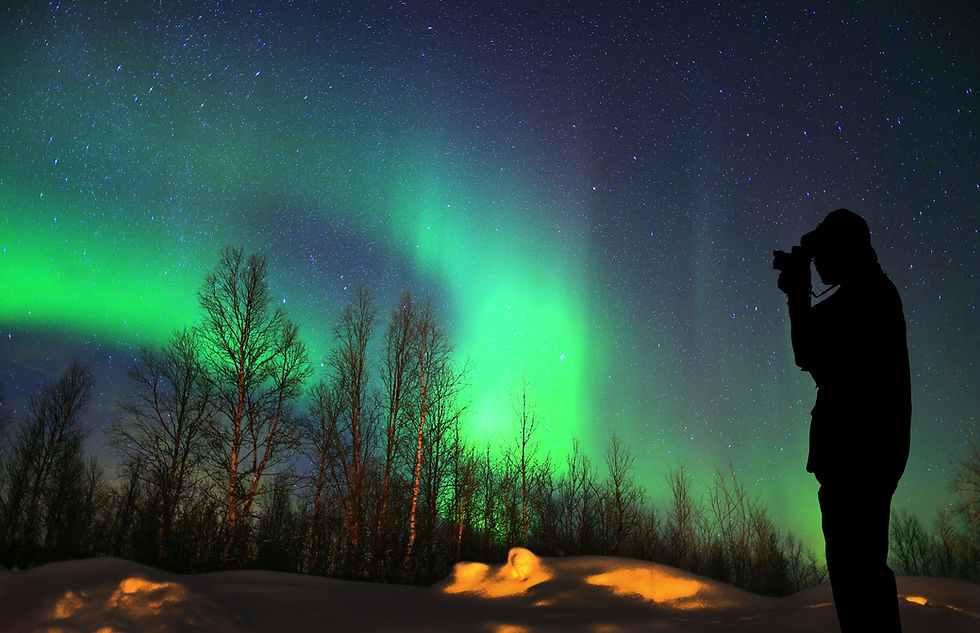
When looking up at the night sky, most of us see stars and constellations. At Orion, we see features invisible to the naked eye—features which provide crucial data to our evolving understanding of Earth's polar upper atmosphere. The Earth's polar atmosphere is a beautiful, chaotic mess of slow-moving neutral and charged particles combined with insanely fast-moving ions traveling along the Earth's magnetic field. The super-speed particles come from the wind, are generated by the sun, and are the cause of the beautiful green, blue and red auroras which have awestruck humanity for centuries. The neutral portion, however, is much more elusive and requires either satellite-based instruments or clever ground instrumentation to see.
THE CHALLENGE: SEEING THE INVISIBLE
The neutral component of our polar atmosphere has long been the elusive counterpart to its more easily measured ionized companion. While ions readily respond to electromagnetic probing, neutral particles require different approaches—primarily through capturing faint emission lines from species like nitrogen, oxygen, hydroxyl and heavy metals.
This isn't just challenging science; it's expensive science. The high-precision instruments needed to detect subtle signals represent significant investments in construction, deployment and maintenance. With limited resources, a crucial question emerges: Where should we place these precious few instruments to maximize scientific return?
THE BREAKTHROUGH: PREDICTIVE MODELING FOR STRATEGIC DEPLOYMENT
At Orion, we've developed a groundbreaking forward-modeling algorithm that changes the game. Our innovative approach predicts what these instruments would observe at any location, allowing us to identify optimal deployment sites before expensive equipment ever leaves the lab.
Our method builds upon first-principles physical models like the Thermosphere-Ionosphere-Electrodynamics General Circulation Model (TIE-GCM) and the Global Ionosphere-Thermosphere Model (GITM). We then incorporate the GLobal airglOW (GLOW) model to calculate three-dimensional emission rates for various atmospheric emission lines.
What makes our approach unique is how we translate these complex atmospheric models into practical deployment guidance:
We interpolate emission rates and wind speeds onto potential instrument line-of-sight vectors
Calculate probability density functions for neutral gas particle speeds at points along this line-of-sight
Integrate these distributions to determine what the instrument would actually "see" at each location
REAL-WORLD IMPACT: MAXIMIZING SCIENTIFIC RETURN ON INVESTMENT
This isn't merely academic—it's about making smarter decisions with limited resources. By predicting instrument performance before deployment, we can position our observational assets where they'll provide the most valuable data about ion-neutral interactions during geomagnetic events.
The implications extend beyond atmospheric science. This methodology represents a shift in how we approach complex observational challenges across disciplines: model first, deploy optimally and maximize return on investment.
At Orion, we're proud to lead this evolution in observation strategy. By developing more intelligent approaches to instrument deployment, we're ensuring that each deployment contributes meaningfully to our understanding of Earth's complex atmospheric systems.
The sky holds countless secrets—our job is making sure we're looking in exactly the right places.
For more expert insights on space science research, visit orion.arcfield.com/knowledgexchange.
ABOUT THE AUTHOR
Matthew “Coop” Cooper is an aerospace engineer on Orion’s space domain awareness team. Matt also works with both civilian and defense-related ground- and space-based optical systems. Matt attended the University of North Alabama and received a dual degree in physics and mathematics with a minor in chemistry, and a Ph.D. in applied physics from the New Jersey Institute of Technology.


